
A playful look at how fencing evolved from ancient sword fights to a modern sport.
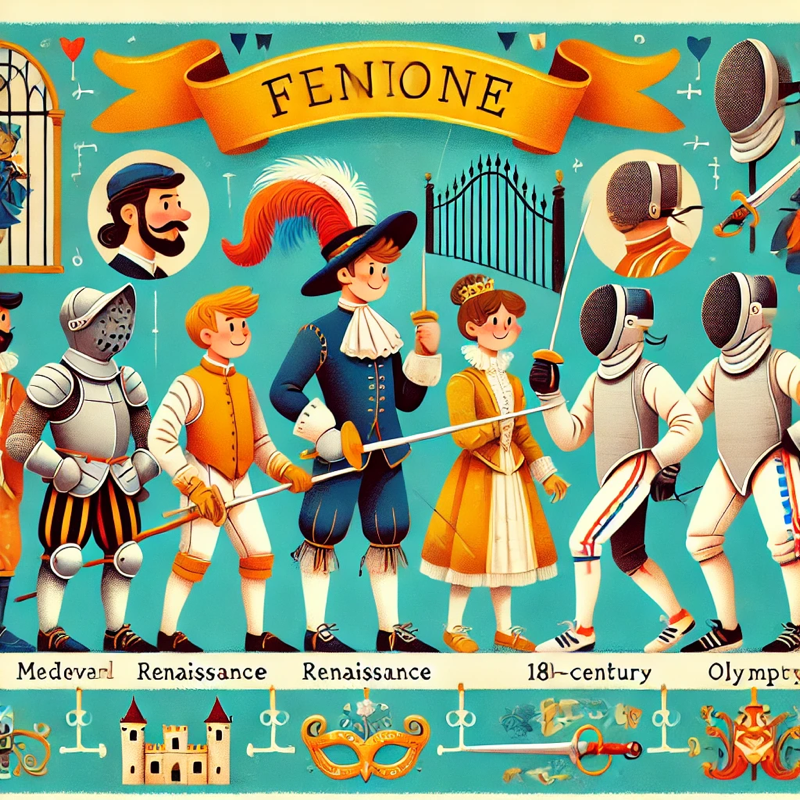
Fencing isn’t just a modern sport with fancy lights and electronic scoring—it’s part of a long, exciting story that began centuries ago, when people used real swords in battles and royal duels. Today, we play a safer, faster, and more strategic version of those old sword fights, but the thrill of crossing blades has stayed the same!
Ancient Beginnings
• Egypt and Rome: Long ago, ancient warriors trained with swords, learning skills to protect themselves. Some of the earliest recorded “fencing-like” lessons come from Egyptian tomb paintings and Roman gladiator schools.
• Not Just for Battle: Even back then, people realized that practicing with swords could be fun and help improve focus, balance, and agility.
Medieval Knights and Renaissance Duels
• Knights in Armor: In the Middle Ages, knights wore heavy armor and fought with big, heavy swords. Over time, swords got lighter, and the focus shifted from brute strength to speed and technique.
• Renaissance Swordplay: In places like Italy and Spain, noblemen practiced dueling to settle arguments or prove their bravery. These sword fights were often choreographed with stylish moves that started to look more like modern fencing.
The Birth of Modern Fencing
• Practice Makes Perfect: As real duels became less common, practice weapons like the foil were developed. People wanted to learn the art of fencing without the risk of serious injury.
• Fancy Footwork: Fencing schools popped up all over Europe, particularly in France and Italy, where masters taught footwork, attacks, and defenses—codifying a system that’s similar to what we use today.
Fencing in the Olympics
• A Star Attraction: Fencing was included in the very first modern Olympic Games in 1896. Back then, it looked different from today’s electronic scoring, but it was still all about speed, technique, and precision.
• Women in Fencing: Women officially joined Olympic fencing events in 1924, and ever since, more and more people of all ages and genders have been able to enjoy this thrilling sport.
Fencing Today
• A Global Sport: Fencing clubs exist all around the world, bringing together people from different cultures to learn and compete.
• High-Tech Touches: Modern fencing uses electronic scoring to detect when a touch (or hit) is made. This speeds up the action and makes matches more exciting to watch.
Why the History Matters
Exploring fencing’s origins helps us appreciate how today’s sport keeps alive the spirit of adventure and fair play from centuries past—without any of the danger of real swords. Next time you pick up a foil, épée, or sabre, remember you’re part of a tradition that goes all the way back to ancient civilizations!
Coming Up Next: In our next post, we’ll look at all the gear that makes fencing safe and fun, from masks to jackets and everything in between!