
Understanding competition formats, scoring lights, and referees.
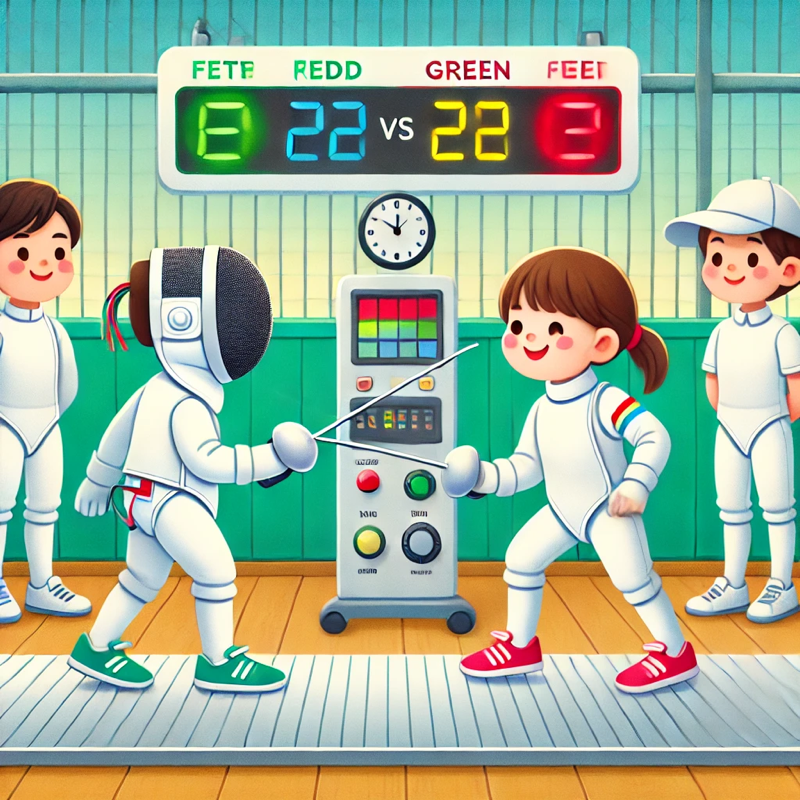
When you watch a fencing bout, you’ll notice two fencers facing each other on a long, narrow rectangle. That rectangle is called the strip (or piste), and it’s where all the action happens! You’ll also see lights flash when someone scores, and a referee keeping track of who gets each point. But how does it all work?
A Quick Story: Sam Sees the Lights
Sam was about to fence in a friendly practice match. Stepping onto the strip, Sam noticed cables attached to each fencer’s sword, leading to a box with red and green lights. “Why all these wires?” Sam wondered. The referee smiled and said, “They let us know when someone scores!”
During the match, Sam felt a tap on the shoulder and heard a beep. A red light lit up on the scoring machine. The referee awarded Sam’s opponent a point! Even though Sam was a little disappointed to lose that touch, it was exciting to see how the lights made everything clear for both fencers and the audience.
What Is “The Strip”?
• Shape and Size: In official competitions, the fencing strip is about 14 meters long and 1.5 to 2 meters wide. But in practice, many clubs have shorter or slightly narrower strips to fit their space.
• Boundaries: You can’t step off the sides of the strip without risking a penalty. If you retreat beyond the end line, your opponent automatically scores a point. This keeps both fencers engaged and moving strategically.
Scoring and the Lights
• Electronic Scoring Boxes: Fencers wear wires connected to a device that detects when a blade makes contact with a valid target area. If it’s a valid hit, a colored light (usually red or green) goes off.
• Off-Target Hits (Foil Only): If a fencer hits a part of the body that’s not the valid target (like the arms or legs in foil), a white light flashes instead. This doesn’t score a point, but it shows that someone did get hit—just not in the right spot!
• Right of Way (Foil and Sabre): Sometimes, two lights may turn on at once. In foil and sabre, the referee must decide who started their attack correctly first. That person usually gets the point. In épée, both fencers can score simultaneously if they hit within a split second of each other.
The Referee’s Role
• Start and Stop: The referee calls “En garde,” “Ready,” and “Fence!” to start each action. When they say “Halt,” both fencers must stop immediately.
• Scoring Calls: After each touch, the referee explains who made the valid hit (if any) and updates the score.
• Ensuring Safety: The referee also watches for unsafe actions or equipment problems. Their job is to keep the match fair and fun for everyone.
Match Formats
• Practice Bouts: At your club, you might fence to 5 touches (points) or set a time limit. It’s a relaxed way to learn.
• Tournament Pools: You often fence shorter matches (up to 5 touches), and your total wins and losses help determine if you advance.
• Direct Elimination: In bigger competitions, matches might go up to 10 or 15 touches, where the winner moves on to the next round, and the loser is eliminated.
Why Understanding the Strip Matters
Knowing how the strip, scoring lights, and referees work will help you feel more confident during a match. Instead of being confused by the lights and calls, you’ll understand exactly why each point is awarded. That means you can focus on what really matters—showing off your best fencing moves!
Coming Up Next: Ready to set goals and track your improvement? Our next post will show you how to make each practice count with Training with Purpose—stay tuned!